A useful break room starts with the people who actually use it. A corporate address in Westshore, a distribution operation near Port Tampa Bay, and a staff lounge in Clearwater may all ask for vending, but their schedules and access conditions can produce very different recommendations. The right starting point is a small site assessment, not a machine selected from a photograph.
This guide helps facility managers, business owners, and property teams prepare that assessment. It covers everyday attendance, equipment choices, placement eligibility, physical access, product planning, and operational responsibilities. These are planning suggestions rather than equipment specifications or a promise of service at every address. Use the Tampa Bay service-area directory to explore your area, then confirm the actual address and requirements in your quote request.
1. Count daily users, not just employees on payroll
A company's total headcount tells only part of the story. Record how many people are normally onsite on each weekday and during each shift. Separate permanent staff, regular contractors, visitors, and employees who work remotely. A building with a large roster but low daily attendance may need a compact machine, while a smaller operation with several busy shifts can need more stock capacity.
For an initial assessment, keep a simple attendance log over a representative working week. Write down shift starts, break windows, approximate onsite attendance, and existing food options. If that week includes an unusual shutdown or training event, say so. Avoid presenting a busy event day as typical demand. The operator needs an honest picture to propose equipment that can stay useful between visits.
Ask how much time people have to buy food and whether they can leave the property. A short break, badge-controlled exit, or distant parking lot can make nearby refreshments valuable. However, convenience alone does not establish enough sales to support a particular installation. Treat expected purchases as a hypothesis to review after launch, rather than a guaranteed forecast.
For multiple shifts, look at the smallest shift as well as the largest. A cooler that seems full at midday may have little useful food left for overnight staff. Include any locked doors or restricted floors between the equipment and the people it should serve. A machine cannot support a shift that has no permission to reach it.
2. Match the plan to your workplace setting
Westshore and Tampa offices
In an office setting, start with the actual in-office calendar. Recurring meetings, hybrid attendance, and tenant move-ins can change demand substantially. Ask the property manager whether a shared lobby installation is allowed, or whether the refreshments must remain inside the tenant suite. In a shared building, distinguish the tenant requesting service from the party that can approve installation.
Coffee and water may be a stronger first priority than a wide fresh-food selection. If an employer already buys snacks, record that spending and the time spent replenishing them. A managed pantry program may address that workload, whereas employee-paid vending solves a different need. A staff survey can identify preferences, but use attendance and actual purchasing behavior to size the final installation.
Port-adjacent logistics and East Hillsborough operations
For industrial or logistics facilities, document gate access, delivery windows, required safety orientation, and the approved pedestrian route to the break room. Make sure a service visitor can reach the equipment without crossing an active loading area. A warehouse manager's approval may need to be coordinated with security, facilities, or a separate property owner.
Port Tampa Bay's operations department describes coordinated safety work and annual hurricane preparedness exercises. For a nearby workplace, that provides useful context for asking about access restrictions and operational continuity. It does not imply that Tampa Bay Vending serves the port or any tenant. Your facility's own access and emergency procedures determine how service visits can be arranged.
Consider whether staff need sealed snacks, larger beverages, or a meal option that can be purchased quickly. Avoid relying entirely on an app if phones are restricted in the production area. Test the proposed payment method at the exact break-room location, where walls or machinery may affect connectivity, before making it the only option available.
Pinellas healthcare and hospitality staff spaces
A staff lounge and a public waiting room have different users and security requirements. In healthcare settings, confirm whether the proposed area is for employees, patients, or visitors, and ask the facility team about infection-control and delivery policies. Do not assume an open market is suitable merely because the building has a large number of occupants.
For hospitality teams, separate employee breaks from guest amenities. Staff may work before restaurants open or after they close, and an overnight housekeeping or maintenance team may have different needs from daytime administration. Describe those patterns in the proposal. A reliable basic selection can be more useful than a large product range that sells slowly and produces waste.
Apartments and shared amenities
For a multifamily property in St. Petersburg, Brandon, or Riverview, occupied units are not the same as daily customers. Identify where residents already gather, how they gain access, and whether the equipment is reachable during evening hours. Discuss camera policies, resident communications, visitor access, and who handles complaints. Outdoor placement should require equipment and site conditions specifically suited to it.
3. Choose the service model before choosing the cabinet
Traditional vending keeps products enclosed and can suit a compact room or an area with public access. A combination machine may be appropriate where space is limited, but the right capacity depends on usage and product size. Ask about the proposed payment methods, accessible controls, stock capacity, and service arrangements for that specific model.
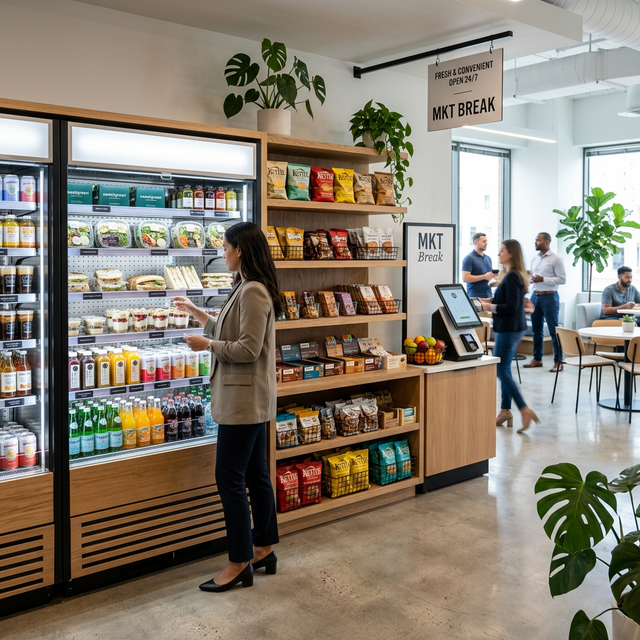
A micro market uses open shelves, coolers, and self-checkout. It can support a broader selection and make labels easier to browse. It also needs more thought about controlled access, checkout instructions, cleanliness, and stock loss. Headcount alone should not decide suitability: attendance consistency, room layout, purchase demand, and security all matter.
Smart vending may include inventory monitoring or different checkout technology. Ask the provider to explain exactly what the equipment does. Confirm connectivity needs, payment authorization, customer refund procedures, and what happens during a network outage. Features vary by model, and an AI label should not substitute for a clear description of the customer experience.
Coffee service can be employee-paid or employer-supported, depending on the proposal. List anticipated drink types, daily use, cup sizes, water access, cleaning responsibilities, and consumable storage. Ask whether filters, cleaning supplies, cups, and milk alternatives are included. A good coffee plan includes the work required to keep the equipment clean, not simply its menu.
Water options may include packaged drinks or a filtered dispenser. For filtered equipment, facilities staff should review the proposed plumbing connection, drainage if required, maintenance, and filter replacement. Pantry service usually means the employer pays for products available to staff. Keep these models separate when comparing proposals so that a product subsidy is not mistaken for free supply.
4. Understand what no-cost placement means
No-cost placement can be available when an operator expects purchases to support equipment, deliveries, stock handling, and normal servicing. Eligibility depends on site access, traffic, demand, location, and the proposed equipment. There is no universal employee-count rule that guarantees approval. A low-volume site may receive a different recommendation or a proposal with costs that need explicit review.
Free placement does not mean free products. With employee-paid vending or a market, users generally purchase the items they choose. Employer-funded pantry programs and coffee subsidies create a separate business expense. Electrical work, plumbing, room alterations, special delivery requirements, equipment rental, or optional services may also be separate, depending on the agreement.
Request a written breakdown showing which party provides the equipment, who owns it, what installation includes, and which recurring charges apply. Ask about product prices, applicable fees, subsidies, minimum purchases if any, and removal or cancellation terms. Contract length and response commitments should come from that agreement. Do not assume every provider offers the same terms.
Compare proposals using the same scope. One may include coffee consumables while another covers only machine maintenance. One may propose a small employee-paid machine while another offers an employer-funded pantry. A simple comparison sheet with equipment, products, payer, utilities, installation responsibilities, ongoing charges, and exit terms makes these differences visible before anyone approves the project.
5. Walk the delivery route and inspect the room
Measure the intended wall and the entire path from unloading to placement. Include door widths, turns, thresholds, elevator dimensions, and any stairs. Photograph the route if permitted, while keeping badges, security systems, and personal information out of the images. Equipment dimensions and weight should be checked against the chosen model, not estimated from a stock image.
Mark outlets and ask facilities staff to verify that the electrical supply suits the equipment. Confirm ventilation clearances, door swing, leveling requirements, and space for maintenance access. For coffee or filtered water, discuss plumbing with the relevant building team. Avoid promising that a standard outlet or nearby sink will work until the proposed equipment specifications have been reviewed.
Keep accessible routes, exits, and firefighting equipment clear. Consider how a person using a mobility device would approach the machine, read the selection, use the payment terminal, and retrieve a product. Ask the facility's accessibility lead to review the layout and controls. An attractive cabinet can still be inconvenient if the checkout is blocked by furniture or a queue.
Check room conditions throughout the day. A sunny lobby, enclosed utility room, or poorly cooled warehouse corner may behave differently from an air-conditioned staff lounge. Refrigerated products require appropriate equipment and handling. The site and operator should agree on cleaning around the equipment, waste removal, pest prevention, and what to do if refrigeration or power fails.
6. Build a focused product mix and review it
Start with a manageable selection rather than trying to satisfy every request on day one. Collect preferences from all shifts, including people who do not drink coffee or want alternatives to sugary drinks. Ask about package size, price expectations, meal needs, and clearly labeled choices. Preference surveys help identify demand, but the provider still needs to confirm sourcing and equipment compatibility.
Describe dietary preferences carefully. Request clearly packaged and labeled products instead of promising an allergy-safe environment. People with food allergies need access to ingredient and allergen information, and the operator should explain its procedures. Do not make a general health claim about an entire machine because it contains a few lower-sugar or higher-protein products.
Fresh food requires additional planning for demand, rotation, refrigeration, and unsold items. The Florida Department of Health's food hygiene guidance explains that regulatory responsibilities are shared among state agencies. Ask the operator to identify the applicable requirements for your facility and products; a workplace label alone does not determine the regulator or permit.
Agree on a review process for stockouts, slow sellers, and requests. Track recurring empty selections rather than judging the entire service from one busy afternoon. Review whether a shortage reflects product popularity, machine capacity, or a delivery problem. Likewise, if products repeatedly expire, reduce the selection or quantity rather than continuing the same stock plan indefinitely.
7. Plan everyday support and storm interruptions
Assign a primary workplace contact and a backup. Confirm how to report a failed payment, stuck product, empty machine, or equipment problem, and ask which details help support investigate. A unit identifier and transaction time can be useful. Employees should not have to send full card numbers or other sensitive payment details to a facility manager to request help.
Put the restocking arrangement in writing, including access hours, closures, security changes, and advance notice for unusual events. Discuss service expectations for your address rather than relying on a general response promise. Tell the provider about tenant changes, major staffing increases, shutdowns, or construction that affects demand or delivery access.
Tampa Bay workplaces should include refreshment equipment in their existing continuity planning. Hillsborough County's business continuation resources point businesses toward disaster preparation and recovery support. Pinellas County's emergency information page provides current local emergency updates. Use official instructions and your facility's emergency plan when deciding on closures, access, and reopening.
As a practical planning step, agree who can notify the provider of a closure, who checks the equipment before reopening, and how potentially affected refrigerated stock is handled. Follow the applicable food-safety procedures and operator guidance. A machine's ordinary inventory is not an emergency food or water reserve. Keep emergency supplies and employee safety planning separate from the normal vending arrangement.
8. Prepare a clear proposal request
Send the business name, site address, contact details, and requested service model. Include typical daily attendance by shift, access hours, public or staff-only use, and the available space. Mention existing equipment and whether it belongs to another provider. If you are replacing a service, review the current removal agreement before scheduling a new installation.
Add your preferred timing and explain any fixed deadline. A tenant opening date, renovation, or upcoming inspection can affect the sequence of work. Ask what must happen before installation: landlord approval, utility work, delivery access confirmation, or product selection. A written schedule should identify dependencies rather than present an installation date as unconditional.
Before accepting the proposal, check the equipment list, payment methods, responsibilities, eligibility terms, charges, and cancellation arrangements. Name the people who can approve the work and receive service updates. If the project involves several buildings, decide whether each needs its own assessment and whether the proposal covers all locations or only the first phase.
A launch checklist for the workplace team
- Confirm property permission, delivery access, and required utilities.
- Review the final layout, clearances, and accessible approach.
- Approve the initial product mix and the payment or subsidy model.
- Document routine cleaning, restocking, support, and removal responsibilities.
- Share checkout instructions and support details with every shift.
- Schedule a first review using actual attendance, purchases, and feedback.
After launch, compare the service with the problem you wanted to solve. Are overnight staff finding useful products? Has the employer's snack-ordering workload changed? Are users clear about payment and refunds? Practical observations help refine the setup. Keep the first review focused on adjustments you can make, rather than treating the initial equipment choice as permanent.
Start with a site assessment
The strongest Tampa Bay refreshment plan fits the workplace's attendance, space, access, budget, and responsibilities. It may start with one vending machine, a secure micro market, or a focused coffee and water program. Keep costs and placement eligibility clear, use written service terms, and review the results after the equipment is in use.
Request a Tampa Bay workplace quote with your address, daily attendance, shifts, and preferred service. You can also compare the service options or read our micro market and traditional vending comparison before submitting your assessment details. A useful proposal begins with a realistic description of your site.
Local source links reviewed October 5, 2026. Planning recommendations are editorial guidance. Availability, placement approval, equipment features, charges, and service commitments must be confirmed in your proposal.